
Architecture
The SDK is a surface architecture, not a thin JSON-RPC wrapper. Each layer has a specific trust boundary and public vocabulary.
For a file-by-file view of these layers in runnable Electron and web projects, begin with the generated target tour. This page explains the deeper runtime boundaries behind both scaffolds.
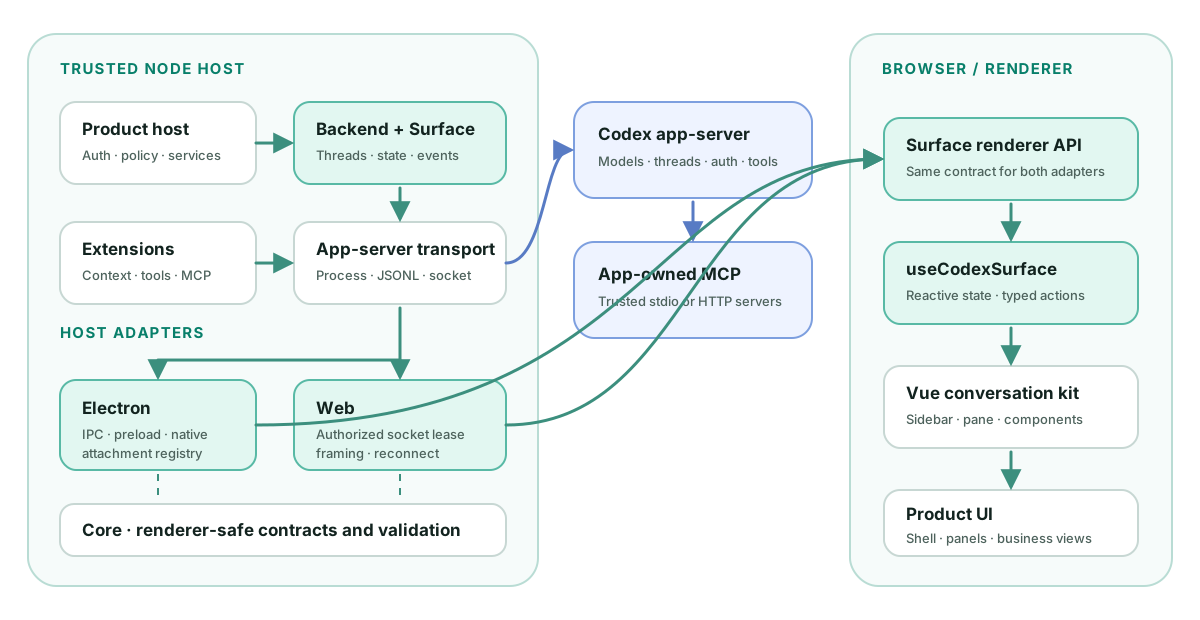
Modular packages
| Package | Owns | Must not own |
|---|---|---|
@codex-app-sdk/core | Renderer-safe surface, bridge, event, attachment, and host-capability contracts | Node, Electron, Vue, or generated app-server code |
@codex-app-sdk/backend | Trusted Node app-server runtime, process transports, CodexSurface, backend composition | Website users, product data, or UI |
@codex-app-sdk/vue | Reusable conversation controller, components, and scoped theme | Backend processes or host transports |
@codex-app-sdk/electron | Main/preload/renderer IPC and native desktop capabilities | Product orchestration |
@codex-app-sdk/web | Established-WebSocket surface projection and browser client | HTTP frameworks, website authentication, user storage, or runner pools |
The root codex-app-sdk package is a compatibility facade while applications migrate to explicit packages. Core is the shared vocabulary; Electron and web are sibling adapters over the same surface bridge, so operation validation is not duplicated between frontends.
Node runtime
CodexSurface owns the app-server client and turns a volatile protocol into a product-shaped state machine:
- executable discovery and child-process lifecycle;
- initialization and reconnect behavior;
- authentication-dependent bootstrap;
- global conversation/model/plugin catalogs;
- one runtime per loaded conversation;
- history and live-notification projection;
- approvals and app-server client requests;
- semantic events emitted after state mutation;
- host extensions, dynamic tools, and MCP configuration.
Snapshots are the authoritative bootstrap and resynchronization mechanism. Events are ordered incremental integration signals. High-volume remote hosts can initialize createCodexConversationReplica() from one targeted snapshot and then reduce only semantic conversation events locally, avoiding a full transcript transfer for every token.
CodexAppBackend is the in-process composition root for applications that need product services around that runtime. It creates or adopts one CodexSurface and gives named application modules the shared surface plus one idempotent backend-close operation. Modules own app concepts such as teams or agents; the SDK continues to own product-neutral Codex connection, catalog, conversation, queue, and event behavior. The embedding application still chooses the process and transport boundary, so this composition does not require another daemon. See Add a backend service for the module contract and shutdown lifecycle.
Electron bridge
The bridge projects CodexSurfaceApi into validated IPC handlers. The renderer can create conversations with a model, reasoning effort, or an advertised approval preset, but it cannot submit raw cwd, approvalMode, permissionMode, config, commands, environments, MCP definitions, extension context, or protocol envelopes.
Native file, clipboard, link, and transcription operations use explicit typed handlers instead of exposing Node or Electron objects.
Web bridge
The web server binds an established WebSocket only after a host authorization callback grants a connection-scoped surface lease. The browser receives the same renderer-safe API used by the Vue controller in Electron. The SDK owns framing, correlation, validation, ordering, snapshots, events, and bounded reconnect; the embedding website owns HTTP, site authentication, tenancy, stable per-user codexHome selection, process pooling, quotas, persistence, and upload endpoints. See Web integration.
Vue kit
useCodexSurface keeps a reactive snapshot synchronized with the renderer API. CodexConversationPane consumes the controller and composes the standard conversation experience.
Hosts with their own renderer state can use the grouped pane controller instead of forwarding dozens of props/events. That controller is a view adapter and is separate from the trusted CodexAppBackend composition root. See Conversation pane integration.
Applications can progressively customize:
- semantic theme tokens;
- capability and presentation props;
- scoped slots;
- exported leaf components;
- a fully custom renderer over the same surface contracts.
State ordering
For a meaningful app-server update, the surface:
- validates and adapts the protocol payload;
- mutates the relevant conversation/global state;
- notifies snapshot listeners;
- emits the matching semantic event with a monotonic sequence number.
An event handler can therefore read the updated snapshot immediately.
Conversation identity
The global catalog is intentionally not filtered by an implicit working directory. A configured cwd scopes new/resumed runtime behavior, while listConversations({ cwd }) is an explicit query.
Several loaded conversations can stream simultaneously. Selection is a UI concern, not a runtime ownership constraint.
Hosts that bridge one CodexSurface to several independently active agents should use the conversation-targeted helpers from @codex-app-sdk/core/surface-bridge. Each invocation and subscription is keyed by conversationId and delegates to surface.conversation(conversationId), so messages, turn actions, approvals, and stream updates never depend on the surface's UI selection. The original global bridge remains available for single-pane Electron and web clients whose operations intentionally follow the active conversation.
Conversation state notifications are scoped to the conversation that changed. Global catalog and authentication updates still notify every subscribed conversation. Consumers should keep message identities stable and prefer semantic events for incremental integrations instead of repeatedly projecting or serializing complete transcripts.
History loading and Vue mounting are separate policies. The surface can keep full-detail history available while the renderer mounts only its newest bounded window. See History and performance.
Advanced protocol access
When app-server adds a method that the surface does not yet project, use the low-level client in the trusted host. Convert the response into a serializable product contract before crossing IPC.
If ordinary renderer code needs thread/*, turn/*, or generated app-server types, extend the surface boundary instead.